
Fencing
Horizontal Cedar
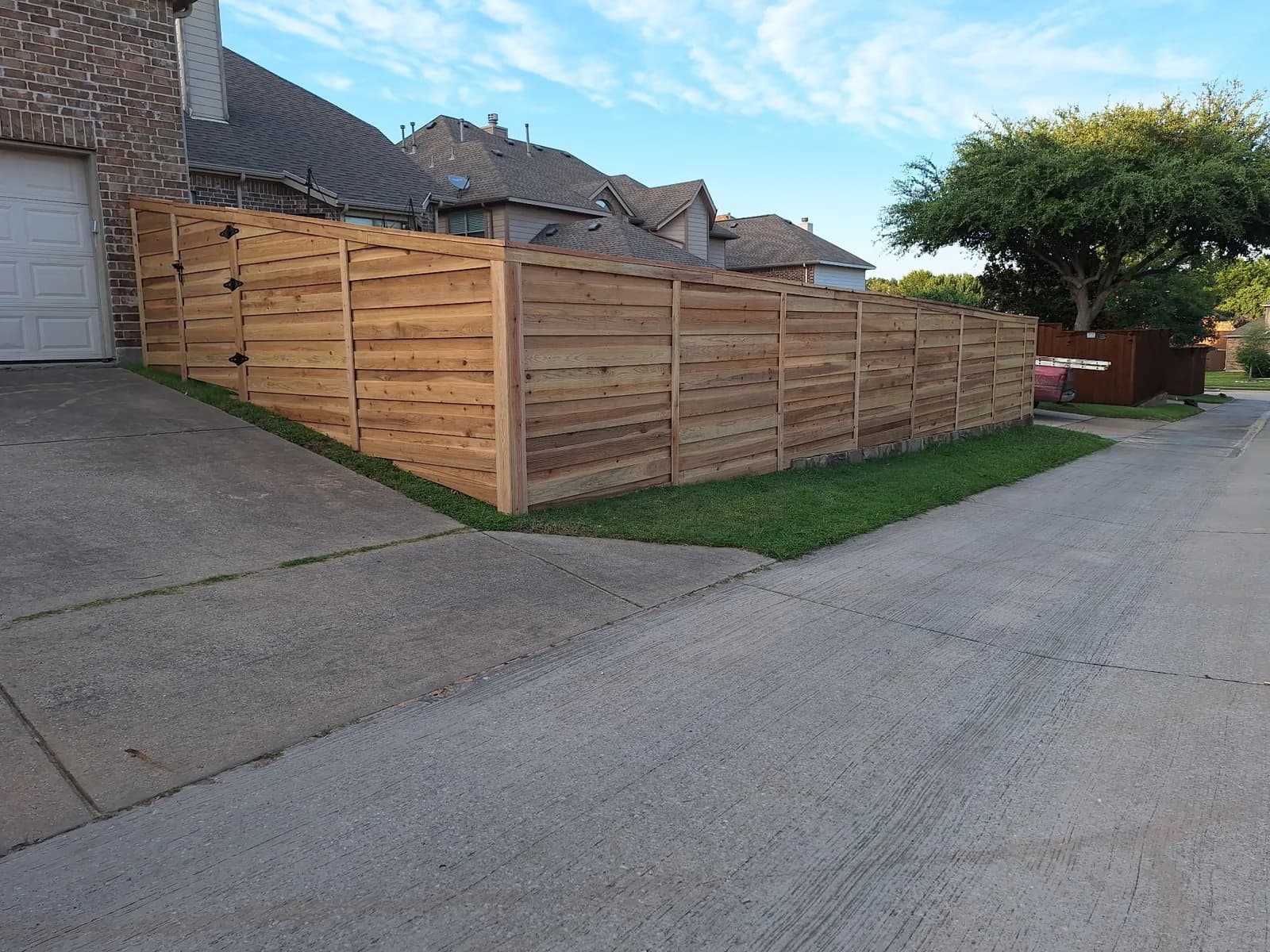
Cedar run horizontally instead of vertically, on a frame built for it.
What it covers
Steel or cedar posts, reinforced framing, gap spacing to your preference, matching gates, stain and seal.
The detail
How it's built.
Horizontal reads cleaner and more current than a standard picket fence, and it is genuinely harder to build well. That's the trade.
A vertical picket is supported along its whole length by rails behind it. Turn the boards sideways and each one is now spanning from post to post on its own. Shorten the spans, beef up the frame, or watch it wave.
Gap spacing is a real decision, not a detail. Tight for privacy, spaced for airflow and a lighter look. Either is fine; picking one after the boards are up is not.
Sideways boards need an upright frame. That's the whole secret.
What goes wrong
Horizontal is where a weak frame shows immediately. Boards running sideways have nothing to brace against, so they bow and wave between posts if the spans are too long or the framing is undersized. A horizontal fence is a framing job with cedar on it.
Questions
- Does horizontal cost more than standard?
- Usually, yes — the framing behind it is heavier and the post spacing is tighter. You're paying for structure, not for the direction of the wood.
- Will the boards sag?
- Not if the spans are right. Sag is a framing failure that shows up in the cedar, which is why we size the frame to the run instead of the other way around.
Horizontal Cedar across the service area
Before you decide
Pressure-treated posts vs cedar
Are pressure-treated fence posts bad?
Board-on-board vs side-by-side
What is the difference between board-on-board and side-by-side fence?
Horizontal vs vertical fence
Is a horizontal fence better than a vertical one?
What drives the cost of a fence
Why do fence quotes vary so much?
Cedar vs pine fence
Is a cedar fence better than pine?
Metal vs wood fence posts
Should I use metal or wood fence posts?
Also in fencing
Start here
Tell us what you want built.
Send the details. We'll set up a time to come walk it.